
Pittsburg County Arrest Records and Court Charges
A Pittsburg County arrest record is the record of an arrest itself. It shows who was taken into custody, the agency that made the stop, and the booking that followed at the county jail. An arrest does not decide guilt. It only marks the start of a path that may lead to court. After the arrest, the District Attorney for District 18 reviews the case that law enforcement refers. The prosecutor then decides which charges to file. Those filed charges go to the Court Clerk and become the court charge record. James Green serves as the Acting District Attorney for the district, which covers Pittsburg and Haskell counties.
The arrest side and the charge side are two different records. Booking detail, custody status, and the current jail list sit with the Sheriff's Office. For that side, the county jail roster and booking information are covered on the Pittsburg County inmate records page. The court charge record is what the prosecutor actually filed. It tracks each count through the case as the matter moves forward. Court charges after arrest can grow, shrink, or fall away as a case develops. The full case file, the plea, and the final outcome live in the criminal court records for the county.
The county describes the Sheriff's duties, including jail operation and warrant service, on the county sheriff page.
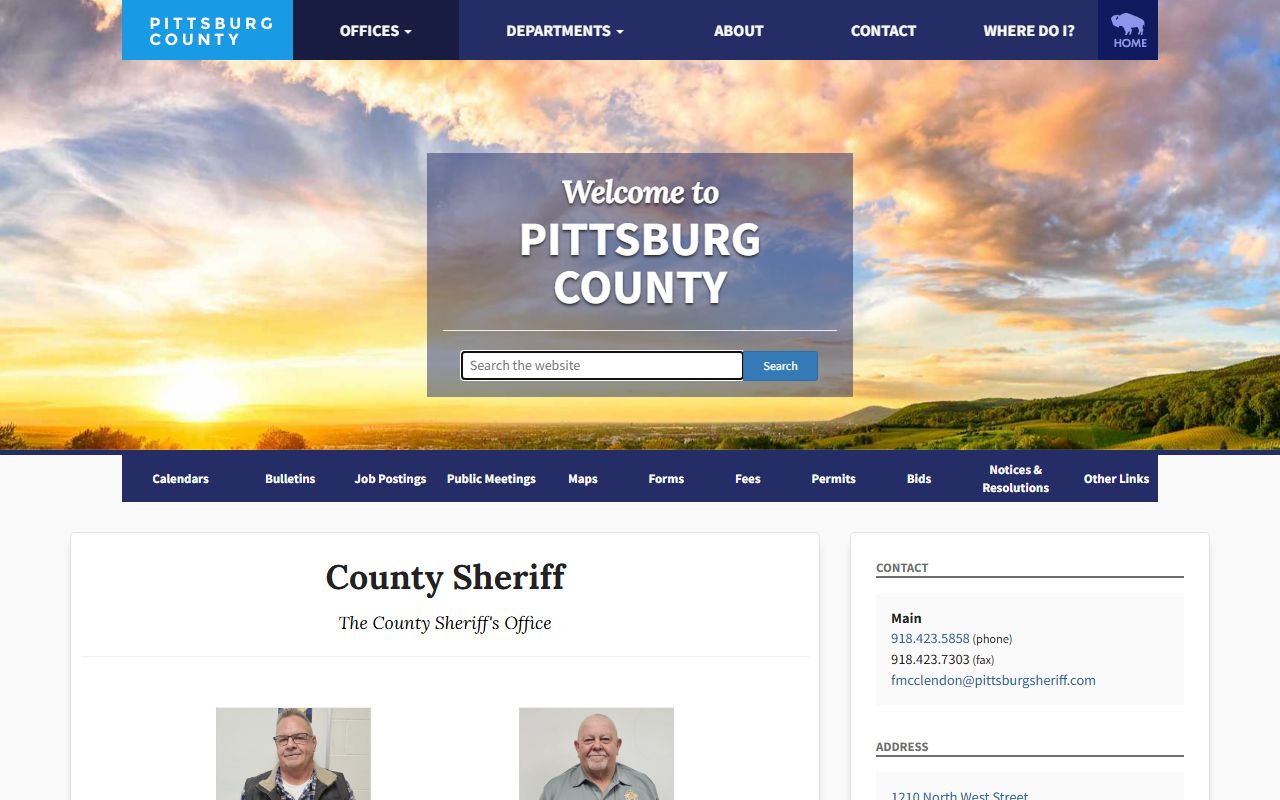
Those duties explain why the arrest and booking side of a Pittsburg County arrest record starts with the Sheriff's Office, not the court. The charge record begins only after the case reaches the prosecutor.
How to Find Pittsburg County Arrest Records and Charges
Court charges in Pittsburg County are searched through the state court systems. The Court Clerk keeps the permanent case files, and two online tools let the public find them. The Oklahoma State Courts Network, known as OSCN, hosts District Court dockets. On Demand Court Records, or ODCR, is the portal the county links for court records. Both let a person search by name or case number and then open the list of filed charges. The arrest and booking detail itself does not show there. That part appears on the Sheriff's jail roster instead.
- Open OSCN docket search or the ODCR portal and choose Pittsburg County.
- Search by the defendant's name in last, first order, or by the full case number.
- Open the case to read the list of counts the State filed.
- Check each charge for its statute code, its level, and its current status.
A filed charge that ends in a sentence can also appear in statewide records that reach beyond the county jail.
Not every charge runs through the District Court. McAlester Municipal Court handles city ordinance and municipal traffic charges, and the OSCN citation search does not include municipal citations. A charge filed by the city is searched through the McAlester court, not the county district docket. That split matters when a person cannot find a charge in the state system. The case may simply live in a city court instead.
Note: OSCN states that its online case information is not the official record and should be confirmed with the Court Clerk who keeps the file.
How Pittsburg County Charges Get Filed After an Arrest
The charge record begins with a charging document. After booking, the prosecutor files a written accusation that names each offense. The kind of document depends on the offense and how the case enters the court. Oklahoma cases use a few main forms. A misdemeanor or a first filing often starts with a complaint. Many felonies move forward on an information filed by the prosecutor. The most serious felonies can come through an indictment returned by a grand jury. Each one opens a case and sets the counts the defense must answer.
Not every arrest leads to a filed charge. The District Attorney's office reviews what law enforcement refers and may decline to file, file fewer counts, or file different ones than the arrest listed. Oklahoma court systems even track a criminal not-filed category. In that case the arrest can stand in the booking record while no court charge follows. This is one more reason the arrest record and the charge record do not always match.
| Complaint | Information | Indictment | |
|---|---|---|---|
| Filed By | Officer / Prosecutor | Prosecutor | Grand Jury |
| Common For | Misdemeanors | Many felonies | Serious felonies |
| Starts | The case | The case | The case |
Soon after a case opens, the defendant appears in court, and the Sheriff's Office posts initial appearance times on its court information page.
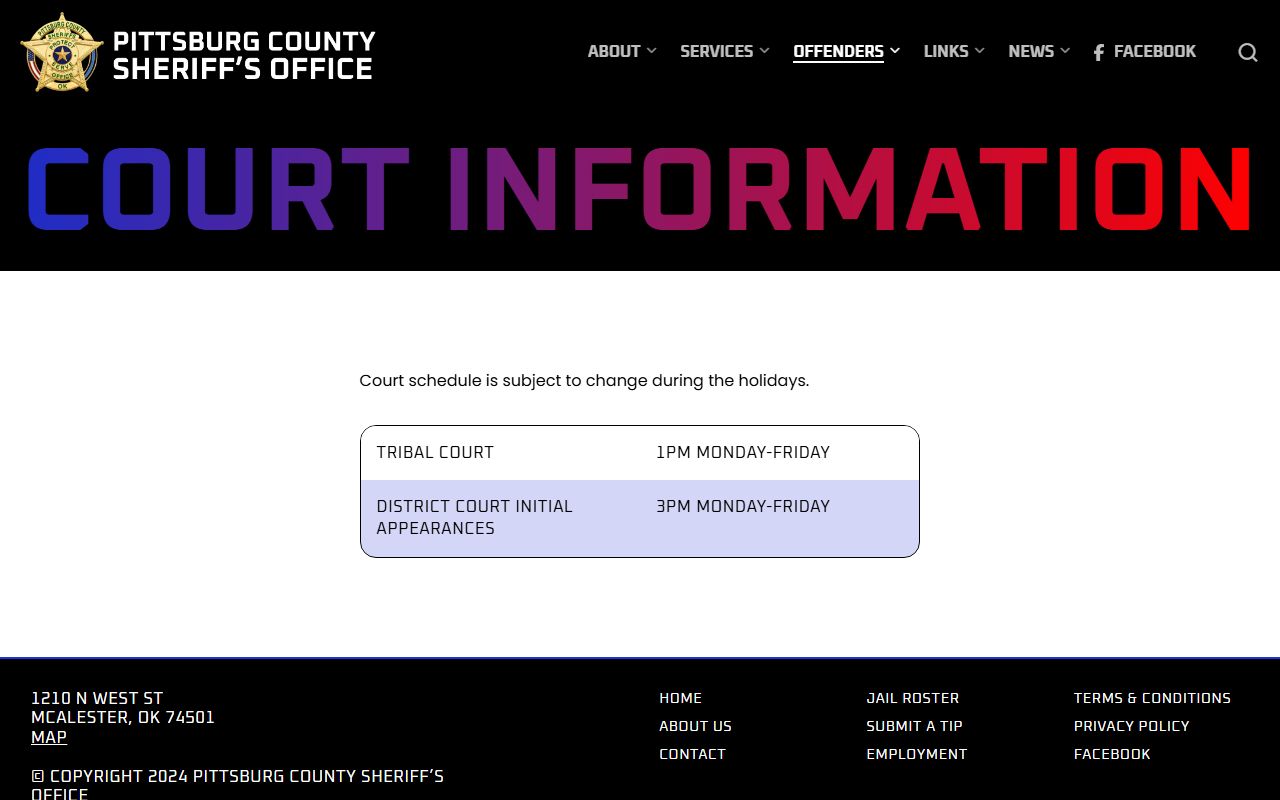
The page lists District Court initial appearances at 3 PM on weekdays, which is often where court charges after arrest are first read aloud to the defendant.
Charge Status in Pittsburg County Court Records
A charge is not fixed once it is filed. As a case moves, counts can be amended, reduced, added, or dropped. The court docket records each change with a date. Reading the current status tells you where a charge stands today, not just where it began. Some charges end without a trial. A prosecutor may drop a count, or the court may dismiss it. The terms below show up often in Pittsburg County court records.
The docket also shows events tied to a charge, such as a bond amount or a bench warrant for a missed court date. These entries sit beside the count and help explain why a charge stands where it does.
| Status | What It Means |
|---|---|
| Pending | The charge has been filed and the case is still open, with no final outcome entered yet. |
| Amended / Reduced | The prosecutor changed the count, often to a lesser offense or a different statute. |
| Dismissed | The court ended the charge, either with or without the chance to refile it. |
| Nolle Prosequi | A formal notice that the prosecutor will not pursue the charge any further. |
Pittsburg County Charge Codes and Severity Levels
Each charge ties to a statute. The court record lists a code, the offense name, the law that was allegedly broken, and the date of the offense. Oklahoma sorts crimes into levels. A felony is the most serious class and can bring prison time. A misdemeanor is a lower level, often punished by jail, a fine, or both. Traffic and minor matters can fall lower still. One arrest can produce several separate charges. A single booking may list a felony count, a misdemeanor count, and a traffic count at once, each with its own code and its own status.
Case numbers also carry a prefix that signals the charge category. Common prefixes in Pittsburg County District Court include:
- CF for criminal felony cases
- CM for criminal misdemeanor cases
- TR for District Court traffic cases
- CV for civil cases
- PO for protective orders
Charges vs. Convictions
A charge is an accusation, not a finding of guilt. When the State files a count, it claims that probable cause supports the arrest and the filing. A conviction is different. It comes only after a guilty plea, a no-contest plea, or a verdict that proves the charge beyond a reasonable doubt. Both a charge and a conviction can appear in the public court record. The status field is what separates the two. A person can be charged and later cleared, so the outcome matters as much as the filing.
| Charge | Conviction | |
|---|---|---|
| Stage | Accusation | Verdict or plea |
| Burden of Proof | Probable cause | Beyond reasonable doubt |
| Public Record | Yes | Yes |
Statewide Charge and Criminal History Lookups
County charges do not always stay in one place. When a charge leads to a state sentence, the record can move into statewide systems. The Oklahoma Department of Corrections runs an offender lookup for people in state prison, on supervision, or listed as fugitives. It is not the county jail roster. For custody alerts, Oklahoma VINE lets the public register for notice by phone, email, text, or app when a custody status or case event changes. These tools help track a charge after it leaves the local court.
The Oklahoma Attorney General explains how OK VINE sends custody and case alerts, and the public can register on the VINE portal.

Alerts like these help victims and the public follow Pittsburg County arrest records and charges as a case moves through custody and on toward a final outcome.
Sealed and Expunged Pittsburg County Charge Records
Some charge records leave the public view. Oklahoma law lets qualifying records be sealed or expunged by court order. A person starts by checking eligibility under the state expungement statute, then files a petition in the district court where the case sits. The District Attorney and affected agencies may get notice and a chance to object. If a judge grants the order, the Court Clerk and agencies restrict public access to the record. The two outcomes are not the same, as the table shows.
| Sealed | Expunged | |
|---|---|---|
| Visibility | Hidden from public | Destroyed / treated as never existed |
| Law Enforcement | Limited access | Very limited |
| Eligibility | Allowed for qualifying cases under 22 O.S. 18 | Petition filed under 22 O.S. 19; the court decides |
Note: A sealed or expunged case may not appear in an online search, so a missing record does not always mean no charge was ever filed.
Background Check Considerations
People often look up charges as part of a background check. A casual search of court records is not the same as a regulated background check. Formal screening for jobs, housing, or credit must follow the Fair Credit Reporting Act, which sets rules on accuracy, consent, and the right to dispute. Court and jail records can carry errors or lag behind the live case, so a charge shown online may already be dismissed. Anyone making a decision under the FCRA should use a compliant consumer reporting agency, not a quick public lookup.
Important: This site is not a consumer reporting agency under the Fair Credit Reporting Act, and its records may not be used for employment, tenant, credit, or other FCRA-regulated decisions.
Restricted Charge Records in Pittsburg County
Not every charge is open to the public. Juvenile charges are confidential under Oklahoma law and are not searched like adult cases. Records that a court has sealed or expunged drop out of public view. Some dismissed counts may be withheld, and material tied to an open investigation can stay closed until the case ends. For any record that does not appear online, the Court Clerk is the office that can confirm whether it is public, restricted, or simply not posted.
- Juvenile and youthful offender matters
- Sealed or expunged cases
- Adoption and certain family records
- Some mental health proceedings
- Sealed search warrants and ongoing investigations