
What Probate Covers in Pittsburg County
Probate handles what happens to a person's money, land, and belongings after they die. It confirms a will if there is one. It names someone to manage the estate. It pays debts and taxes, then passes what is left to heirs. The process also reaches the living, since the same division oversees guardianships for minors and adults who cannot care for themselves.
The work spans more than estates. Pittsburg County probate records include wills and estate administration, letters testamentary or letters of administration, guardianships, conservatorships, and trust proceedings. They also cover the filing of wills along with related petitions. As a case moves forward, the file gathers inventories, notices, orders, accountings, distributions, and final decrees where the law calls for them.
Oklahoma does not run a stand-alone probate court. Probate is a division of the District Court, and the Pittsburg County Court Clerk records, files, and keeps the permanent record of each case. The Court Clerk page lists Probate among the divisions the office serves, alongside Civil, Criminal, Juvenile, Domestic Relations, and Small Claims. That makes the Court Clerk the first stop for most Pittsburg County estate records.
Probate Terms Defined
Probate files use words that rarely come up in daily life. A short guide makes a Pittsburg County probate records search easier to read. The terms below show up across wills, estate files, and guardianship petitions in the Pittsburg County District Court.
- Testator
- The person who made the will. The will speaks for the testator after death and names who should take property.
- Executor
- The person named in a will to carry it out. The court grants letters testamentary so the executor can act for the estate.
- Intestate
- Dying without a valid will. State law then decides who inherits, and the court appoints an administrator to manage the estate.
- Guardianship
- A court arrangement where one person is given legal authority to care for a minor or an adult who cannot manage personal needs.
- Conservatorship
- A court arrangement that gives one person authority over the money and property of someone who cannot manage their own finances.
Note: An executor acts under a will, while an administrator is appointed when there is no will or no named executor able to serve.
How to Search Pittsburg County Probate Records
Two online systems hold most of the public docket data. The Oklahoma State Courts Network, known as OSCN, is the state judiciary docket portal, and you can reach it through the OSCN docket search. The county also links to On Demand Court Records, or ODCR, for participating courts. Both let you search by party name, by case type, or by full case number. Probate cases often carry the PB prefix, such as PB-2013-71.
Pick the system, then choose Pittsburg County District Court and a probate-related case type. ODCR lists probate, guardianship, conservatorship, trust, and filing of wills among its case categories. Search by the decedent's name or the petitioner's name when the portal supports a name field. Online data is a convenience, not the official record, so the District Court still controls what counts as certified.
- Open OSCN or ODCR and select Pittsburg County District Court from the court list.
- Choose a probate case type such as PB, guardianship, conservatorship, or trust, then enter the decedent or petitioner name, or the full case number if you have it.
- Review the docket for parties, filing dates, the judge, and event entries; if no result appears or a document image is missing, contact the Court Clerk because older probate files may not be online.
Note: OSCN states that its online information is not the official court record and should be verified with the record keeper under the Oklahoma Open Records Act.
What Pittsburg County Probate Records Show
A probate file grows as the case moves along. Early papers include the petition to open the estate and the will itself when one exists. The court then issues letters that give the executor or administrator power to act. After that, the file fills with the steps needed to wind up the estate.
Common items in a Pittsburg County estate record include the inventory of property, notices to heirs and creditors, court orders, periodic accountings, and the final decree of distribution. The docket lists each filing by date, with the parties named and any hearing set. Captions for these cases often read "In re" or "In the Matter of" the estate, the will, or the person under guardianship.
Each docket entry shows a date, a short code or description, and the party tied to the action. You may also see the assigned judge and the dates a case was filed and closed. Some documents are not posted online at all. OSCN frequently marks an entry "Document Available at Court Clerk's Office," which means you must request that paper from the clerk in McAlester.
Pittsburg County Probate Division Contacts
Probate runs through the Pittsburg County District Court, and the Court Clerk keeps the files. The Court Clerk page names Pam Smith as Court Clerk and Mary Ford as First Deputy. The office sits in the Pittsburg County Courthouse in downtown McAlester. Mail for case files and copy requests goes to the Court Clerk's post office box. For a deeper look at the office, see the Pittsburg County Court Clerk page.
Pittsburg County Court Clerk (Probate Division)
Pittsburg County Courthouse
115 E Carl Albert Pkwy #1A
McAlester, OK 74501
Mailing: PO Box 460, McAlester, OK 74502
918-423-4859
Fax: 918-426-1886
Monday-Friday 8:00-4:30
Call ahead to confirm counter hours and what a particular file holds. The clerk can tell you whether a probate document is on hand, what a copy costs, and how to request a certified version. A name and a case number speed up any request.
Wills, Estates, and the Small Estate Path
Title 58 of the Oklahoma statutes sets the probate procedure. It says the District Court has power to open and prove wills, admit them to probate, and grant letters testamentary, letters of administration, and guardianship. The court can also revoke those letters when the law allows. The full text appears in the Oklahoma Title 58 probate statute.
Not every estate needs a full case. Oklahoma allows a small-estate affidavit under 58 O.S. 393. When the estate meets the statute's limits and other conditions are met, certain property can pass without a full probate proceeding. This path can save heirs time and cost, but it has strict rules, so many Pittsburg County families confirm eligibility with the Court Clerk or an attorney first.
A will may be filed with the court even before a full estate opens. The filing of a will is its own case category in the docket systems. Estate administration then follows when someone petitions to settle the assets and debts.
Pittsburg County Probate Record Fees
Pittsburg County does not publish a stand-alone probate filing fee table on its official pages. The Court Clerk fee link points to the statewide court fee schedule rather than a local probate chart. Because of that, the safest step is to ask the Court Clerk for the current probate filing fee and the current certified-copy fee before you file or order documents.
The county does publish copy fees on the County Clerk side, and those rates give a useful reference point for paper copies of public records. The table below lists those published amounts. Treat the probate filing and certified-copy lines as items to confirm with the Court Clerk, since those exact figures were not found in the county's online fee material.
| Item | Amount |
|---|---|
| Copy fee (per page) | $1 |
| Certified copy certificate | $1 per certificate |
| Probate filing fee | Ask the Court Clerk |
| Certified copy of a probate document | Ask the Court Clerk |
Note: The $1 per-page and $1 certificate rates come from the county's published copy fees, while probate filing and certified-copy charges must be confirmed with the Court Clerk.
Certified Copies of Pittsburg County Probate Records
Courts, banks, and title companies often want a certified copy rather than a printout. A certified copy carries the clerk's stamp that proves it is a true copy of the court's file. Plain copies pulled from a docket portal do not carry that proof.
To order one from the Pittsburg County Court Clerk, give the case number, the decedent's name, the title of the document you need, and the copy type you want. You can ask by phone, by mail to the Court Clerk's box, or at the courthouse counter. The county did not post an online probate request form, so a call or letter is the practical route. Marriage, divorce, and probate copies all run through this same office, which the Pittsburg County marriage and divorce records page also covers.
Older estate files may sit in storage rather than online. The clerk can confirm whether a record exists and how to obtain it.
Restricted Probate and Guardianship Records
Most Pittsburg County probate filings are open under the Oklahoma Open Records Act. Some related records are not. Guardianship cases that involve a minor can include sensitive details, and parts of those files may be limited to the parties, attorneys, or the court. Adoption records are treated as confidential and are not ordinary public probate files.
Mental health proceedings draw similar care. The docket systems list mental health case categories, but these records can hold treatment information, so access may be restricted. When you are unsure whether a particular record is public, ask the Court Clerk whether it is open, sealed, or subject to a court order. The office can tell you what is releasable without guessing.
Personal identifiers are also held back. Social Security numbers, financial account numbers, and the names of minors are commonly redacted or left out of public copies.
Estates Versus Federal Bankruptcy
People sometimes mix up a deceased person's estate with a bankruptcy estate. They are not the same, and they are not handled by the same court. Probate of a will or an estate is a county matter in the Pittsburg County District Court. Bankruptcy is a federal matter, so it never appears in the Pittsburg County probate docket.
Bankruptcy cases for this region belong to the U.S. Bankruptcy Court for the Eastern District of Oklahoma, based in Muskogee, reachable at 918-549-7200. That court handles its own filings and keeps its own records apart from any county clerk.
The map of the Eastern District helps confirm which federal court serves Pittsburg County.
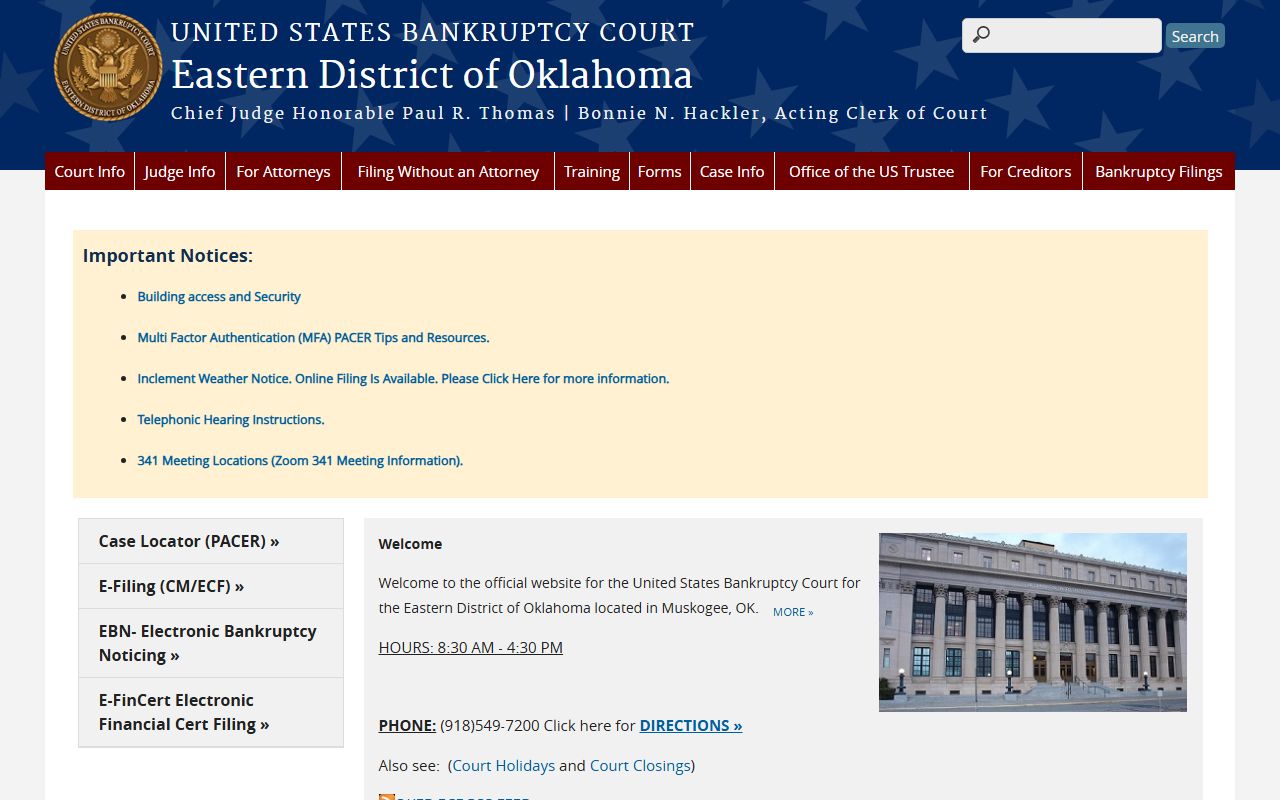
Because a bankruptcy estate is federal, it sits outside the county probate files entirely, even when a family is dealing with both a death and unpaid debts.
Federal bankruptcy records are not searched through OSCN or ODCR. They are pulled through the federal CM/ECF and PACER systems. You can confirm the right court and access path through the bankruptcy CM/ECF court lookup for the Eastern District of Oklahoma.
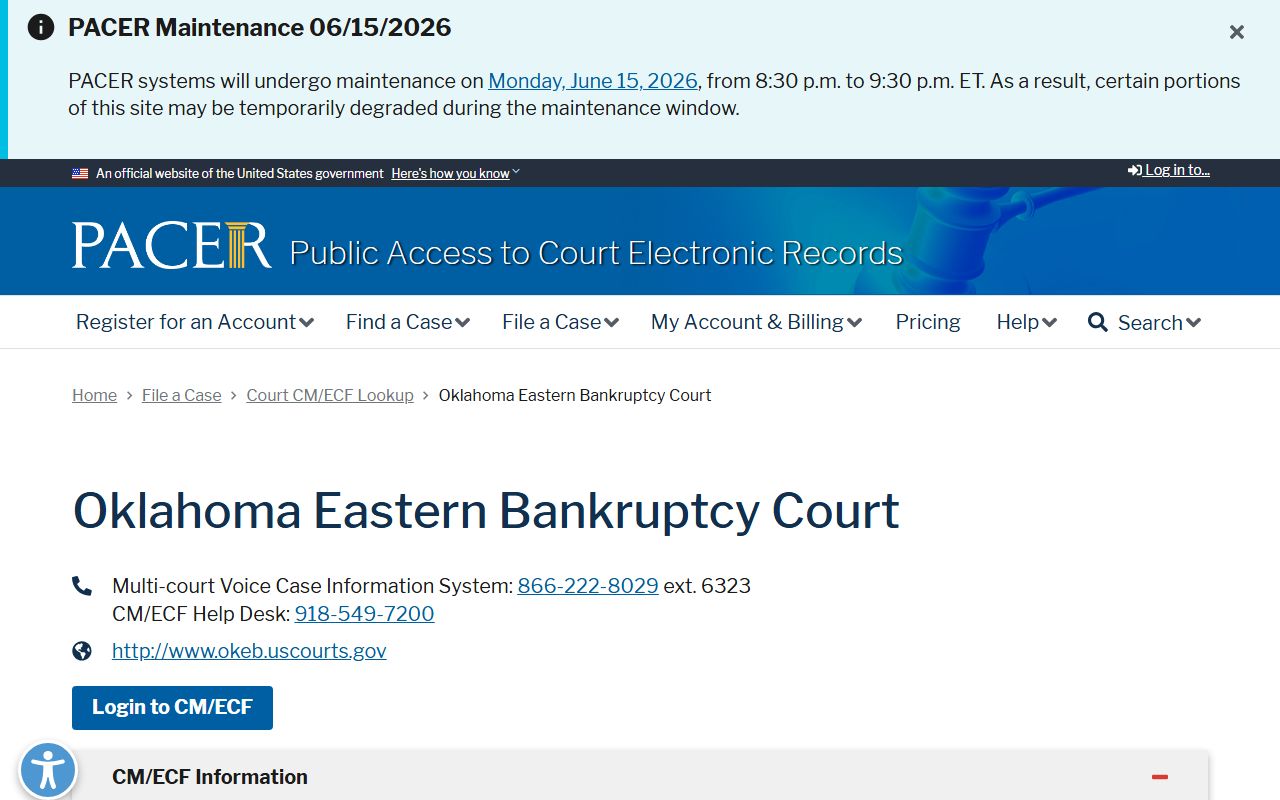
For broad federal access, the main PACER portal serves every federal court, while county probate stays with the District Court and its Court Clerk.