
Criminal Court Records in Pittsburg County
Once the State files charges, the Pittsburg County Court Clerk opens a case file. That office records, files, and keeps the permanent records of all District Court proceedings. The criminal division is one of several the clerk handles, along with civil, probate, juvenile, domestic relations, and small claims. The clerk also keeps the appearance docket, which is the running list of every filing and event in a case. A criminal court record is built from those filings. It holds the charges, the bond, the plea, and the result.
District Court is the main trial court in Pittsburg County. It hears both felony and misdemeanor criminal cases. A felony is a serious crime that can carry prison time. A misdemeanor is a lesser crime with lighter penalties. The county sits in Judicial District 18. City ordinance cases and municipal traffic tickets are handled apart from this. Those run through McAlester Municipal Court and other city courts, and they do not appear in the District Court file. For a wider look at every record type the clerk holds, the Pittsburg County court records page covers all court records.
How to Search Pittsburg County Criminal Court Records
Two free state systems hold Pittsburg County criminal case data. The Oklahoma State Courts Network, known as OSCN, is the judiciary's own docket search. On Demand Court Records, or ODCR, is the portal the county links for court records. Both let you search by name or by case number. The official Pittsburg County Court Clerk page points to each one.
- Open the OSCN docket search and pick Pittsburg County District Court from the court list.
- Search by defendant name, or enter the full case number, such as a CF or CM number.
- Narrow the results by case type and filing date to find the right case.
- Open the case to read the docket, the counts, the plea, and the disposition.
- Request a certified copy from the Court Clerk when you need an official document.
The ODCR portal works much the same way, and it accepts online payments for some courts. OSCN posts a clear warning on its case pages. The online docket is a convenience, not the official record, and it should be checked against the clerk's file. Some documents are not online at all. A page may read "Document Available at Court Clerk's Office," which means you must ask the clerk for a copy.
Stages of a Pittsburg County Criminal Case
A Pittsburg County criminal case moves through set stages, and each one leaves a mark in the record. The case opens when the District Attorney files charges. The defendant is then brought before the court for an initial appearance and arraignment. Felony cases often add a preliminary hearing, where a judge decides if there is enough proof to go forward. After that come pretrial motions, then either a plea or a trial. The case ends with a disposition and, for a conviction, a sentence.
Case flow: Charges Filed › Arraignment › Pretrial / Motions › Plea or Trial › Disposition › Sentencing
At arraignment the defendant hears the charges and learns of the right to a lawyer. Pretrial work covers motions, evidence, and bond terms. A plea or a trial then settles guilt. If the result is a conviction, the judge sets the sentence and the clerk records the terms. The docket shows the date of each step, so the file reads like a timeline.
What a Pittsburg County Criminal Court Record Shows
A Pittsburg County criminal court record is organized into fields that anyone can read. The header names the court and county and gives the case number. Each charge sits in its own count, with a code, an offense name, and the statute the State says was broken. The docket lists every event in date order. Money lines track bond, fines, and costs.
| Field | What It Shows |
|---|---|
| Case Number | A prefix, year, and sequence, such as CF for a felony or CM for a misdemeanor. |
| Caption | The case title, written as State of Oklahoma versus the defendant. |
| Counts / Charge Code | Each separate offense charged, listed with its own count number and code. |
| Statutory Violation | The exact Oklahoma law the State claims was broken. |
| Plea | The defendant's answer to each count, such as guilty, not guilty, or no contest. |
| Disposition | The current or final outcome of each count. |
| Sentence | The penalty after a conviction, such as prison, jail, probation, or a fine. |
| Bond | The amount set for release, plus the bond type or surety. |
| Docket Events | The dated list of hearings, filings, orders, and warrants. |
Reading Dispositions and Sentences
The disposition is the heart of any Pittsburg County criminal record. It tells you how each count ended. A guilty finding, a not-guilty verdict, and a dismissal all read as separate dispositions. A nolo contendere, or no-contest plea, lets a defendant accept the penalty without admitting guilt. A deferred sentence delays final judgment while the defendant meets court terms, and finishing them can lead to a dismissal.
A sentence section spells out the penalty. It may list prison or jail time, probation, fines, court costs, and any credit for time served. Some docket codes are short. A line marked CONVICTED shows the outcome, while cost codes track what is owed. When a code is unclear, the Court Clerk can explain what it means.
- Arraignment
- The hearing where charges are read and a first plea may be entered.
- Plea
- The defendant's formal answer to each charge.
- Nolo contendere
- A no-contest plea that accepts the penalty without admitting guilt.
- Deferred sentence
- A delay of final judgment while the defendant meets set court terms.
- Disposition
- The current or final outcome of a count or case.
Charges vs. Convictions in Pittsburg County
Being charged is not the same as being convicted. A charge is an accusation that the State must still prove. A conviction means a court found guilt, by verdict or by plea. A Pittsburg County criminal court record can show charges that were dropped, dismissed, or that ended in an acquittal. Reading the disposition on each count tells you which is which. A pending charge proves nothing about guilt. For a closer look at how charges are filed and how they change, the Pittsburg County arrest records and charges page covers court charge records in detail.
| Charge | Conviction | |
|---|---|---|
| Stage | Accusation | Verdict or plea |
| Burden of Proof | Probable cause | Beyond a reasonable doubt |
| Decided By | The prosecutor's filing | A judge or jury |
| Public Record | Yes | Yes |
The District Attorney and Pittsburg County Criminal Charges
After an arrest or a police referral, the District Attorney decides whether to file charges. Pittsburg County is part of Oklahoma's District 18, which also covers Haskell County. James Green serves as the Acting District Attorney for the district. His office files the counts, sets the State's position, and carries the case through to disposition. The prosecutor, not the police, controls which charges appear in the court file.
The Oklahoma District Attorneys Council keeps an official page for District 18, which names the prosecutor and lists the offices that serve the county.
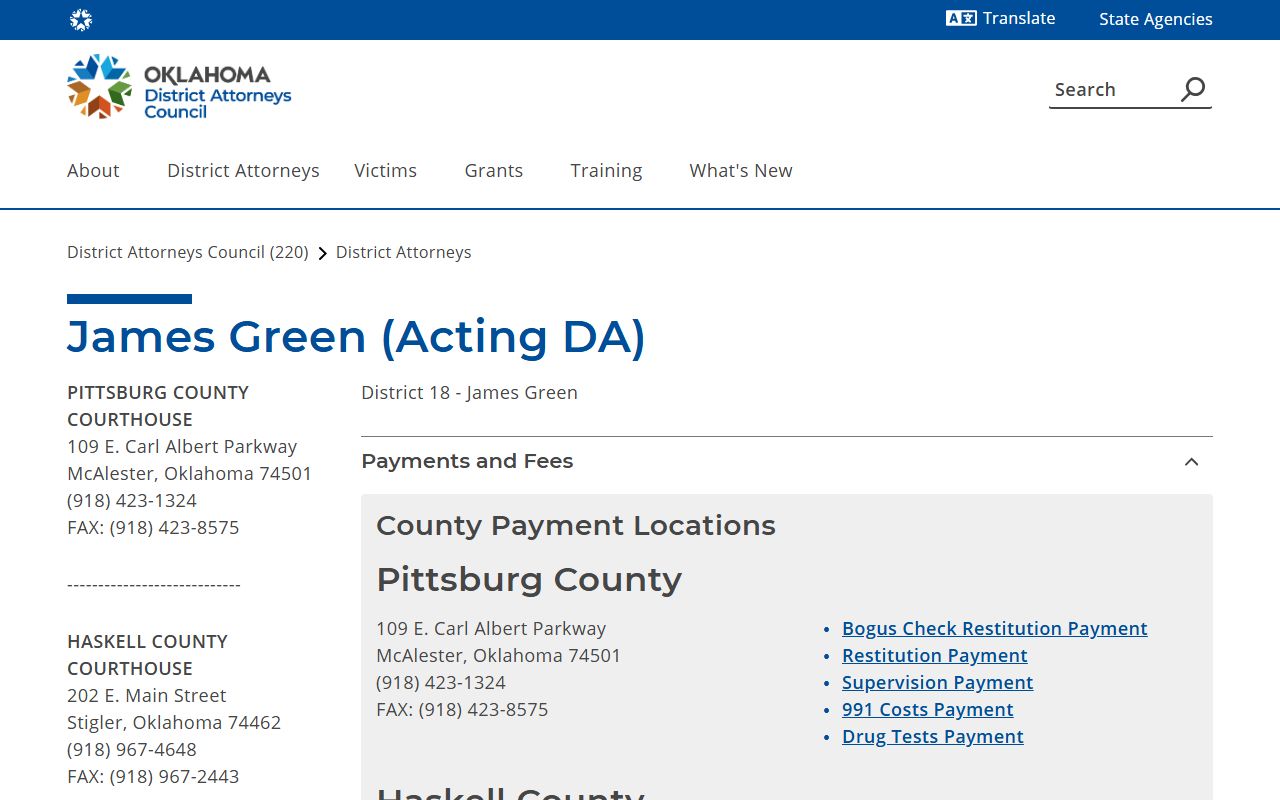
The District 18 office in McAlester is where felony and misdemeanor charges against Pittsburg County defendants are filed and pursued. Its decisions shape every count that later shows up in the criminal court record.
Court-Appointed Defense in Pittsburg County
A defendant who cannot afford a lawyer may receive one at state expense. The Oklahoma Indigent Defense System, called OIDS, provides that defense in most counties. A judge appoints OIDS after deciding that a defendant qualifies as indigent. The agency handles felony cases, misdemeanor cases, traffic cases that can bring jail time, and juvenile delinquency matters. It also takes appeals and post-conviction work.
The state publishes an OIDS agency summary that explains how appointed defense works across the counties it serves.
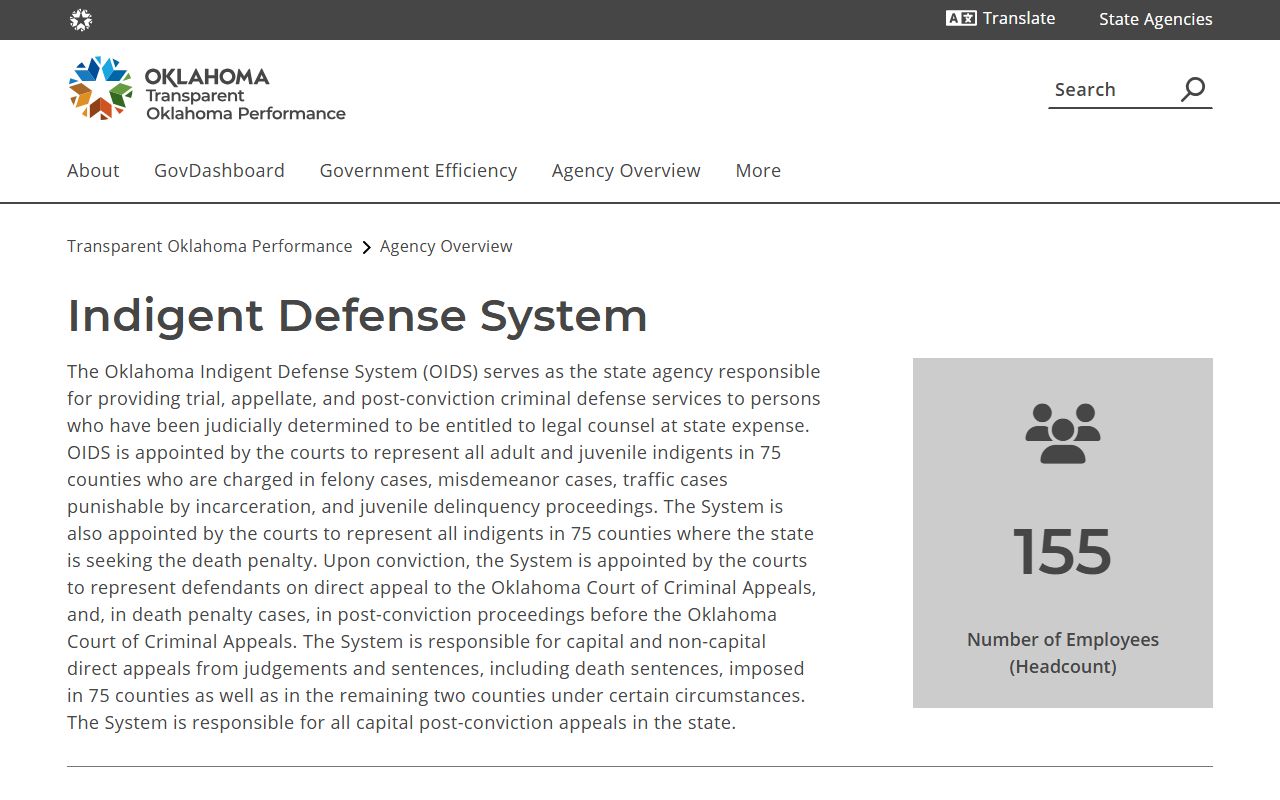
When a Pittsburg County criminal record lists an OIDS attorney, it means the court found that the defendant could not pay for private counsel. The appointed lawyer then appears on the docket the same way a private attorney would.
Sealed vs. Expunged Records in Pittsburg County
Some Pittsburg County criminal records can be hidden from public view. Sealing keeps a record from showing up in a normal search, though it still exists. Expungement goes further and treats the record as if it never happened. In Oklahoma both paths run through the district court under the expungement statutes. A person files a petition, names the agencies involved, and asks the court to restrict access.
| Sealed | Expunged | |
|---|---|---|
| Visibility | Hidden from public search | Treated as if it never existed |
| Record Exists | Yes, but access is blocked | Removed from public access |
| Law Enforcement | May keep limited access | Very limited access |
| Oklahoma Path | Court order under Title 22 | Petition under 22 O.S. 18 and 19 |
Public Access to Pittsburg County Criminal Court Records
Criminal case files in Pittsburg County are public by default. Oklahoma law treats court records as open unless a specific rule restricts them. That is why OSCN and ODCR can post dockets, counts, and dispositions for anyone to read. The same law lets a person request a copy from the Court Clerk. The clerk's file is the official version, and the online docket simply mirrors it.
Key Statutes:
51 O.S. 24A.1, Oklahoma Open Records Act - Court case files are open to the public unless a specific law restricts them.
22 O.S. 18 and 19, Expungement - Qualifying criminal records can be sealed by petition in the district court.
Background Checks and Criminal Records
People look up Pittsburg County criminal court records for many reasons, from screening a renter to checking a name before a hire. A casual lookup on a public portal is not the same as a regulated background check. Formal employment or tenant screening must follow federal fair-credit rules. Court portals show case data, but they are not certified background reports.
Important: Pittsburg County Court Records is not a consumer reporting agency under the Fair Credit Reporting Act, and its data may not be used for credit, employment, tenant, or insurance decisions.
Restricted Pittsburg County Criminal Records and Federal Cases
Not every criminal matter is open to the public. Juvenile cases are confidential under Oklahoma's Title 10A, so they are not searched like adult files. Sealed and expunged cases may not appear at all. Active investigations, sealed warrants, and some mental health proceedings can also be withheld. Personal data such as Social Security numbers is redacted from public view.
Some crimes in Pittsburg County are not handled by the District Court at all. Federal crimes go to the U.S. District Court for the Eastern District of Oklahoma, based in Muskogee, which sits in the Tenth Circuit. Because the county lies in eastern Oklahoma, Indian Country cases can fall under federal or tribal jurisdiction. Those records are kept by the federal court or the tribal court, not the county Court Clerk.